Insights Library

Recovery Readiness Assessments, created for communities, counties, and behavioral health districts across Iowa, help people understand their local substance-use recovery landscape, compare community resources to similar-sized towns, and identify areas that may need additional support.


Reducing Disease Burden by Design: A One Health Approach
Mosquito-borne diseases such as Dengue Fever, Zika, and Malaria remain among Uganda’s most urgent public health challenges, undermining individual well-being, community resilience, and national development. This report demonstrates how regenerative landscape design and low-cost environmental interventions can simultaneously reduce disease risk and strengthen agricultural productivity. Grounded in a One Health framework, this report emphasizes integrated…
Sustainable Agriculture in the Context of High Burden of Disease: A One Health Approach
In July 2025, the Public Science Collaborative research team conducted two weeks of fieldwork in the Busoga region of Eastern Uganda to investigate how cocoa farming practices intersect with environmental and health risks related to mosquito-borne diseases such as malaria. This work builds on a growing body of research that links landscape features and agricultural…
Tailored Recovery: Many Journeys, Multiple Personas
The Public Science Collaborative at Iowa State University conducted journey map workshops throughout the state to document and explore the pathways and experiences of people in recovery from a substance use disorder. The goals of the workshops were to 1) identify unique and emergingpathways of recovery, 2) document real experiences of people navigating recovery services…
Update & Extension of the Recovery-Ready Community Index
As part of the Public Science Collaborative’s substance use recovery work, PSC created a first in the nation, statewide recovery-ready community index (RRCI) comprised of recovery readiness scores for hundreds of Iowa communities. Since 2020, Iowa has witnessed the founding of seven recovery community organizations, including five recovery community centers and two collegiate recovery programs….
Measuring Alcohol Outlet Density in Iowa
As part of Public Science Collaborative’s Alcohol Research Initiative, this overview and explanation of methodology describes PSC’s Iowa Alcohol Density Monitoring Program to help understand the relationship between concentration of alcohol outlets and violence in Iowa.
Designing Safe Neighborhoods in Waterloo
The Public Science Collaborative partnered with the Waterloo Safe Neighborhoods Commission to facilitate a workshop in Waterloo and design neighborhood health and safety strategies. Guiding the discussion was the question: “How can we best use data to support the goals of the Safe Neighborhoods Commision?” PSC conducted an extensive data scan to understand Waterloo assets…
Health & Safety in the Burlington Downtown District
The Public Science Collaborative facilitated a workshop in Burlington to design strategies aimed at improving community health and safety while furthering downtown redevelopment. A diverse group, including representatives of the business community, city government, local non-profits, the health sector, public health, community safety, and ISU Extension gathered to discuss community strengths, opportunities, and actionable solutions…
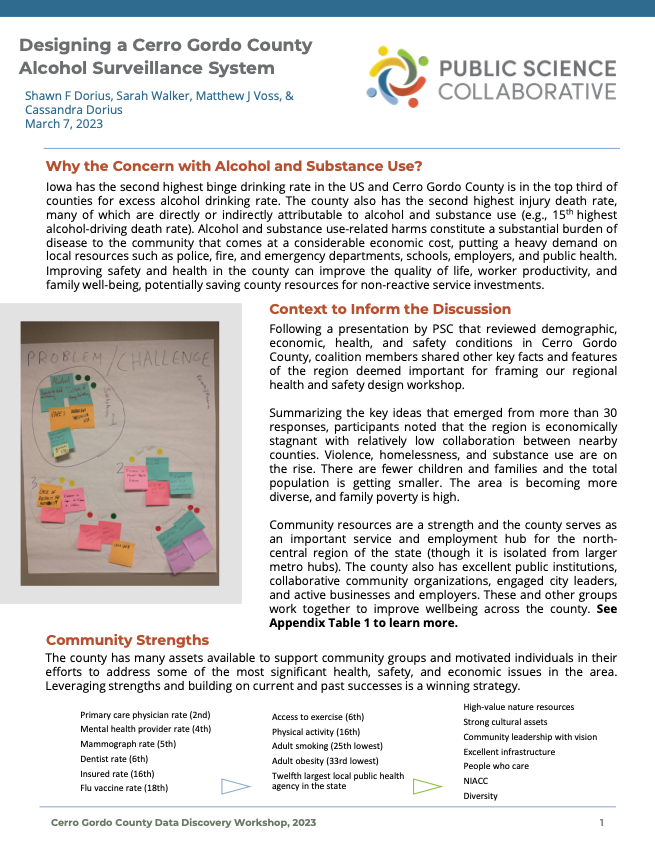
Designing a Cerro Gordo County Alcohol Surveillance System
As part of the Public Science Collaborative’s Alcohol Research Initiative, PSC partnered with Cerro Gordo County to strategize the design of an alcohol surveillance system. PSC worked with the county to identify community strengths, pressing problems, questions to guide action, and understand health and safety data needs.
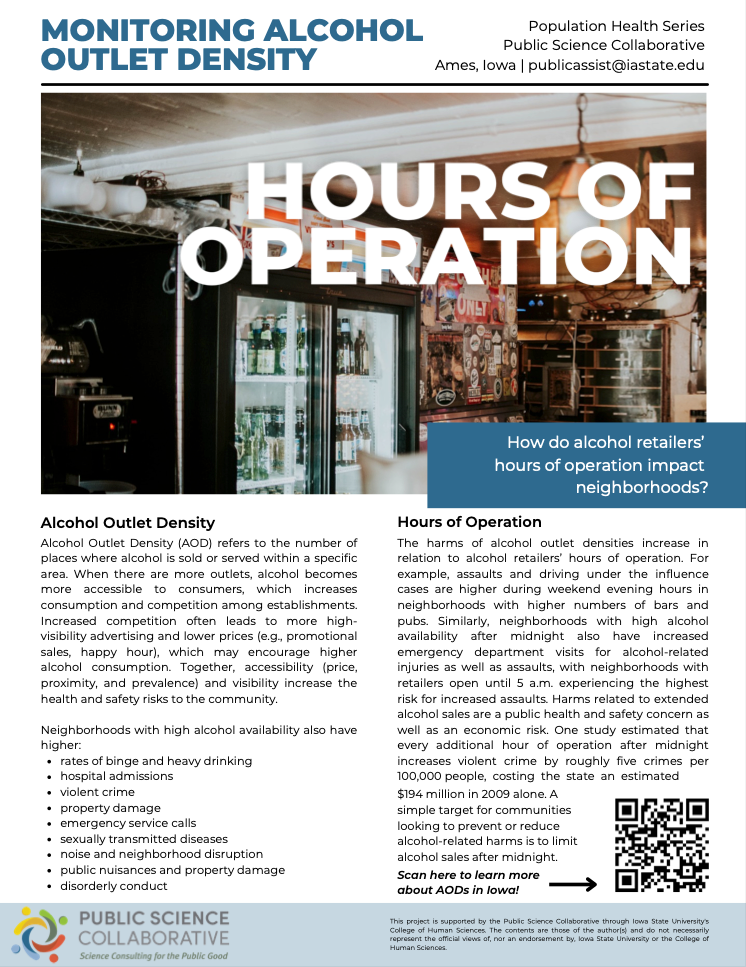
Monitoring Alcohol Outlet Density, Hours of Operation: Quick Reads
As part of Public Science Collaborative’s Alcohol Research Initiative, this quick read highlights the relationship between alcohol retailers’ hours of operation in a neighborhood with its rates of binge drinking, violent crime, hospital admissions, property damage, and other occurrences.
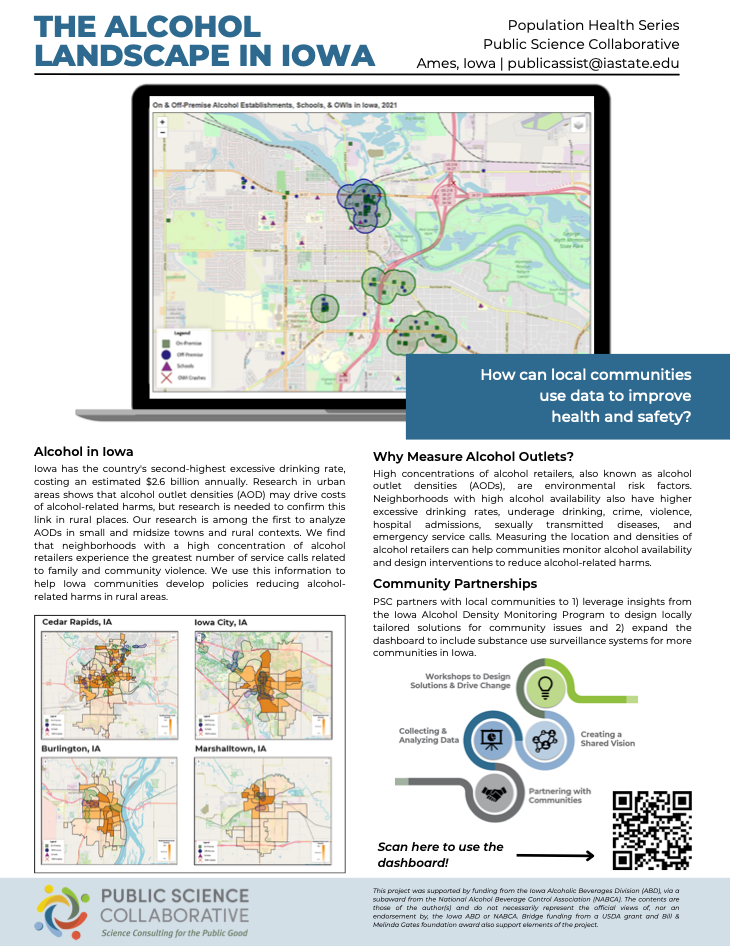
The Alcohol Landscape in Iowa: Quick Reads
As part of the Public Science Collaborative’s Alcohol Research Initiative, this quick read highlights how alcohol outlet densities (AODs) affect Iowa communities, especially in rural areas. This resource supports local efforts to design data-informed policies that reduce alcohol-related harms.
An Ethnographic Assessment of Drug Use among Iowa Families
As part of the Public Science Collaborative’s substance use work, PSC sought to strengthen the Iowa Department of Public Health’s (IDPH) surveillance of substance use in Iowa, with particular attention to intergenerational impacts, through the deployment of an ethnographic assessment of active and former substance users. The goal of these activities is to help IDPH…
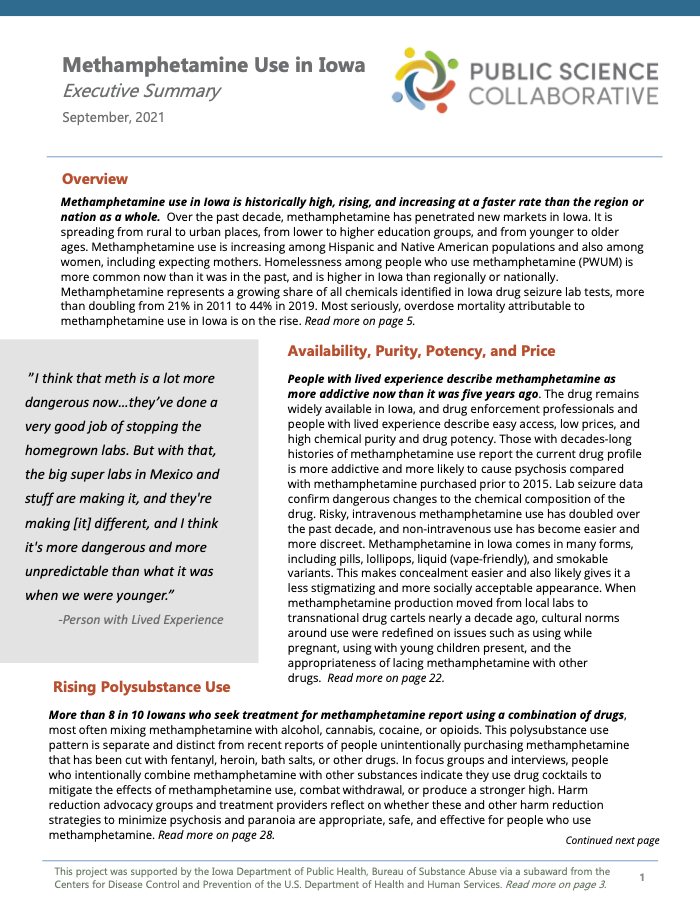
Methamphetamine Use in Iowa, Executive Summary
As part of the Public Science Collaborative’s Substance Use Recovery work, this executive summary shows that Methamphetamine use in Iowa is rising faster than national trends, spreading across diverse populations, increasing overdose risks, and highlighting urgent needs for expanded treatment and support services.